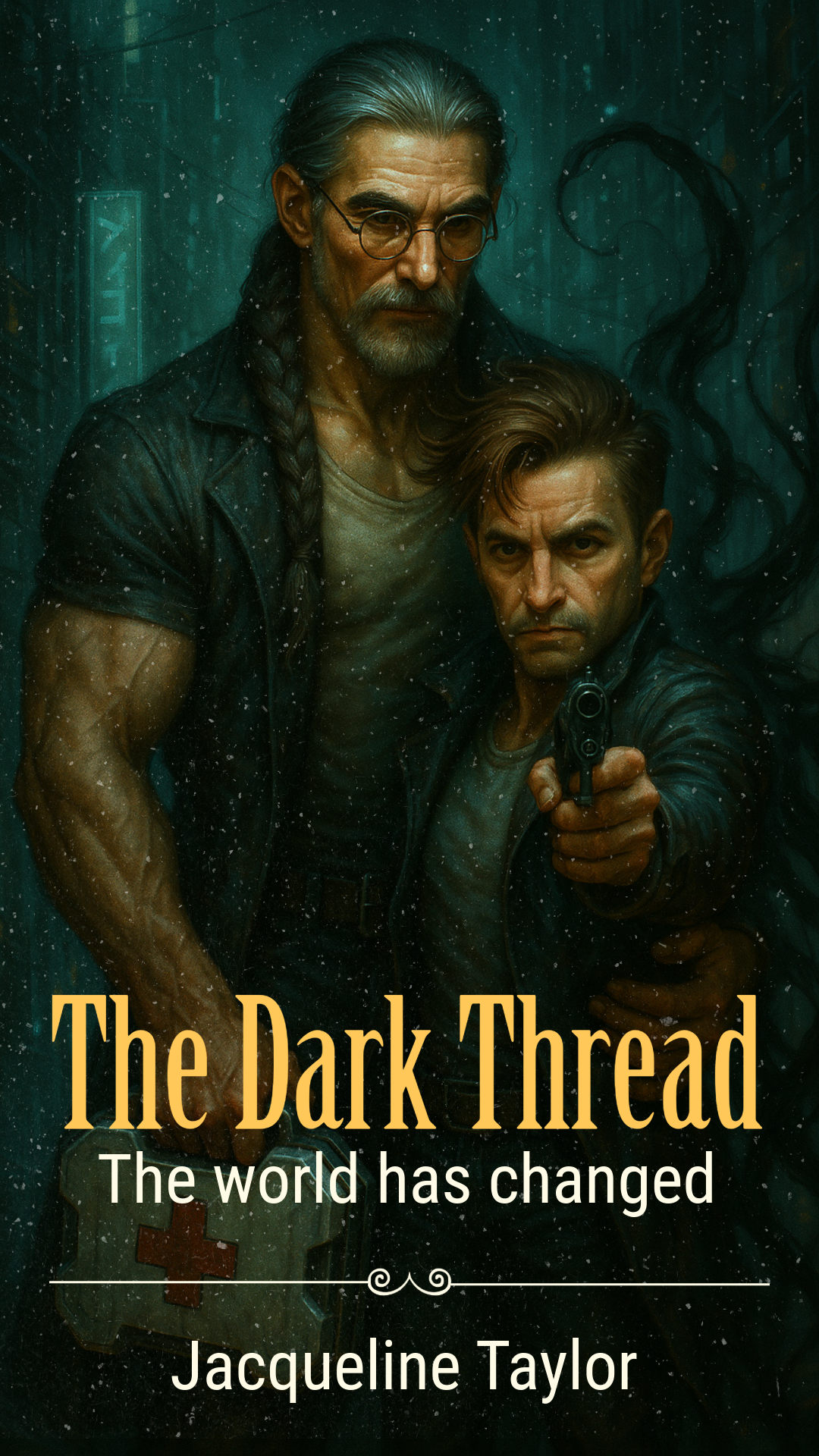

The light in the clinic room was wrong.
Jared noticed it the way he noticed everything now. Not as an assault. Not as a threat. Just a detail. Too clean, too even. A pale wash that did not flicker or hum. No hidden intent. It did not demand his attention. It simply existed. Steady. Neutral. Like a breath held and never released.
Weeks ago, it would have scraped against him. He would have cataloged it, measured it against memories of brighter, harsher rooms. Waiting for it to turn on him. Now he lay back against the bed, hands loose on his stomach, and let the light be what it was.
The bed adjusted itself with a soft mechanical sigh as he shifted. No restraints. No hum of emergency fields beneath him. Only fabric, polymer, the faint warmth of the bed holding his shape.
He stared at the ceiling, tracing the seams where the panels met. He had memorized them early. The pattern had helped when days blurred, when the Dark pressed at the edges of his thoughts and he needed something solid. Now he did not need to count them.
No triumph in the realization. Only a quiet acknowledgment.
He breathed in. Breathed out.
The door slid open without ceremony.
Adrian didn’t announce himself. He never did. The door opened, and there he was, carrying a slim dataslate tucked under one arm, posture relaxed in that way Jared had learned was deceptive. Adrian moved like someone who was always aware of the space he occupied, of how close he was standing, of how much presence was too much.
He wore clinic blues today, sleeves rolled to his forearms, gloves clipped at his belt rather than pulled on. Not in emergency mode. Not on edge.
“Morning,” Adrian said.
“Morning,” Jared replied.
Jared’s voice sounded normal. Rough at the edges, but not strained. Not brittle. He did not clear his throat or brace for the echo inside his skull. He spoke, and the sound stayed where it belonged.
Adrian took that in. Not overtly. Just a flicker of attention, like noting a vital sign without needing to write it down.
“How are you feeling?” Adrian asked, stepping closer, eyes already scanning the monitors lining the wall.
Jared considered the question. Not because he did not know the answer. "Fine" was a shield. Shields were not needed here.
“Steady,” he said finally. “Clear. Tired, but… the normal kind.”
Adrian’s mouth curved, just barely. Not a smile. Only acknowledgment.
“That tracks,” he said. “Your last few scans look good. No spikes overnight. No dissociative markers.”
Jared nodded once.
Adrian moved to the console, fingers moving across the surface. Data scrolled. Biometrics, neural activity, Shadow-resonance. Once, Jared would have flinched. Now he watched, no tension coiling in his chest.
“You slept?” Adrian asked, not looking at him.
“Yes.”
“How long?”
“Six hours,” Jared said. Then, after a pause, “Straight.”
That earned him a look.
Adrian turned, really looked at him. Eyes sharp, assessing, careful. Six hours. Fragile. Something that might shatter if touched.
“Any dreams?” Adrian asked.
Jared shook his head. “Not that I remember.”
No blood-soaked corridors. No screaming minds at the back of his thoughts. No Dark pressing against his ribs, asking to be let in.
Just sleep.
Adrian nodded, satisfied, and returned his attention to the slate.
Silence settled between them. Not awkward. Not empty. It had weight, but not pressure. A quiet that did not need to be filled.
Jared watched Adrian as he worked. The steady movements. The way he anchored one hand on the console while the other scrolled, grounding himself without thinking about it. The faint crease between his brows when he concentrated.
Weeks ago, that crease would have hooked his attention, snagged thoughts he did not want. Now it was just there. A detail. Human.
Adrian finished reviewing the data and set the slate down on the counter with a soft tap.
“Well,” he said, exhaling. “I don’t see a medical reason to keep you here.”
The words landed gently. He felt their weight.
Discharge.
The room did not tilt. His heart did not lurch. No urge to argue. No need to cling to the safety of monitored walls.
Instead, something else.
Readiness.
“Okay,” he said.
Adrian studied him for a moment, searching for something: hesitation, fear, the telltale signs of someone saying yes when they weren’t prepared to mean it.
He found nothing.
“That doesn’t mean we’re done,” Adrian said, tone even. “You’ll still need regular check-ins. Weekly, at least to start. Scans, bloodwork, cognitive assessments.”
“I expected that,” Jared said.
“And you’ll continue the stabilizer regimen,” Adrian added. “At the current dosage. No changes without consulting me.”
"I won't," Jared said. No defensiveness.
Adrian paused. That flicker of attention again. No pushback.
“There is one more thing,” Adrian said, gesturing toward the slim band visible at the base of Jared’s neck, partially obscured by his hair. The cybernetic monitor sat flush against his skin, seamless and unobtrusive, its faint indicator light pulsing slowly.
Jared’s gaze followed the gesture.
“The monitor,” Adrian said. “We can remove it before you leave. That was always an option.”
Jared didn’t answer right away.
He shifted, sitting up more against the bed. The movement was easy. No dizziness. No tremor in his hands as he rested them on his thighs.
“How long would removal take?” Jared asked.
“Fifteen minutes,” Adrian said. “Noninvasive. Minimal aftercare.”
Jared nodded.
“And if I keep it?” he asked.
Adrian didn’t respond immediately. He watched Jared now, openly assessing, not the data but the man.
“If you keep it,” Adrian said carefully, “it continues to transmit baseline and anomaly data. We can restrict access.”
“Currently, it goes to the full clinic network,” Jared said.
“Yes.”
“I don’t want that,” Jared said, simply.
Adrian inclined his head. “That’s reasonable.”
Jared hesitated, just a fraction. Not uncertainty. Only calculation.
“I want the readings to go only to you,” he said.
The words were unadorned. No justification. No explanation. He did not look away. Did not soften them.
Adrian’s breath caught. A tiny hitch, masked at once. His posture stayed loose, professional.
“That’s a significant change,” Adrian said.
“I know.”
“There are protocols,” Adrian continued. “Redundancies. Oversight.”
“I know,” Jared repeated.
Adrian held his gaze. The air between them charged. Not with tension. With meaning.
“Why?” Adrian asked.
Jared considered the question. He could have given an answer that made sense. He could have talked about efficiency, exposure, scrutiny.
He didn’t.
“Because,” he said slowly, “if something changes… I want you to see it first.”
Not to catch it. Not to fix it. Only to see.
Adrian’s expression did not change. But his eyes softened. Recognition there, beyond the professional.
“That places a lot of responsibility on me,” Adrian said.
“I know,” Jared said again.
There it was. Not spoken outright. Not named. Jared trusted him.
Not with his life in the dramatic sense. He had trusted others with that before, in chaos and breach. This was different. Quiet. Ongoing. A steady, deliberate placing of something vulnerable into Adrian’s hands.
Adrian nodded once.
“Alright,” he said. “We can do that.”
No hesitation. No warning. Only acceptance.
“I’ll need your authorization,” Adrian added. “And I’ll document the change.”
“Do it,” Jared said.
Adrian turned to the console, fingers moving with precision. Lines of code flickered across the screen. He entered his credentials, then paused, glancing back at Jared.
“This means I’ll see everything,” Adrian said. “Baseline fluctuations. Stress responses. Sleep patterns.”
“I know.”
“Even things you might not want anyone else to know.”
Jared met his gaze. His voice was steady when he replied. “That’s the point.”
Adrian held his eyes for a long moment. Then he nodded and completed the authorization.
A soft chime sounded as the system accepted the change.
“Done,” Adrian said. “Routing restricted. Encrypted. Only my access key.”
Jared exhaled. He had not realized he was holding his breath until it left him.
Adrian noticed.
“Any discomfort?” Adrian asked, stepping closer to examine the monitor.
“No,” Jared said. “Feels the same.”
Adrian reached up, fingers hovering near Jared’s neck. Not touching. Not yet. He paused. A silent question.
Jared tilted his head slightly, granting access without words.
Adrian adjusted the monitor with gentle precision, checking the seal. His touch was brief. Clinical. Not cold.
“Alright,” Adrian said, stepping back. “You’re cleared.”
The word settled in his chest. Warm. Solid.
Adrian handed him a folded set of discharge papers and a small case of medication. Their fingers brushed as Jared took them. Accidental. Fleeting.
Neither of them commented on it.
“You’re free to go,” Adrian said. “But I’ll expect to see you in a week.”
“You will,” Jared said.
Adrian hesitated, then added, “If anything feels off before then, anything, you contact me.”
“I will,” Jared said, without hesitation.
Not if. When.
Adrian nodded.
Jared swung his legs over the side of the bed and stood. The floor was solid beneath his feet. Not too solid. Not unreal.
He shrugged into his jacket, movements unhurried. At the door, he paused. Hand resting against the frame.
“Adrian,” he said.
“Yes?”
Jared turned back. For a moment, it seemed he might say something else. Something heavier. Instead, he said, “Thank you.”
Adrian met his gaze, understanding layered beneath the simple words.
“You’re welcome,” he replied.
Jared left the clinic. Didn’t look back.
Adrian watched the door slide shut. He stood for a long moment, one hand on the console where Jared’s data streamed. Quiet. Steady. Alive.
He didn’t smile.
But he breathed a little easier.